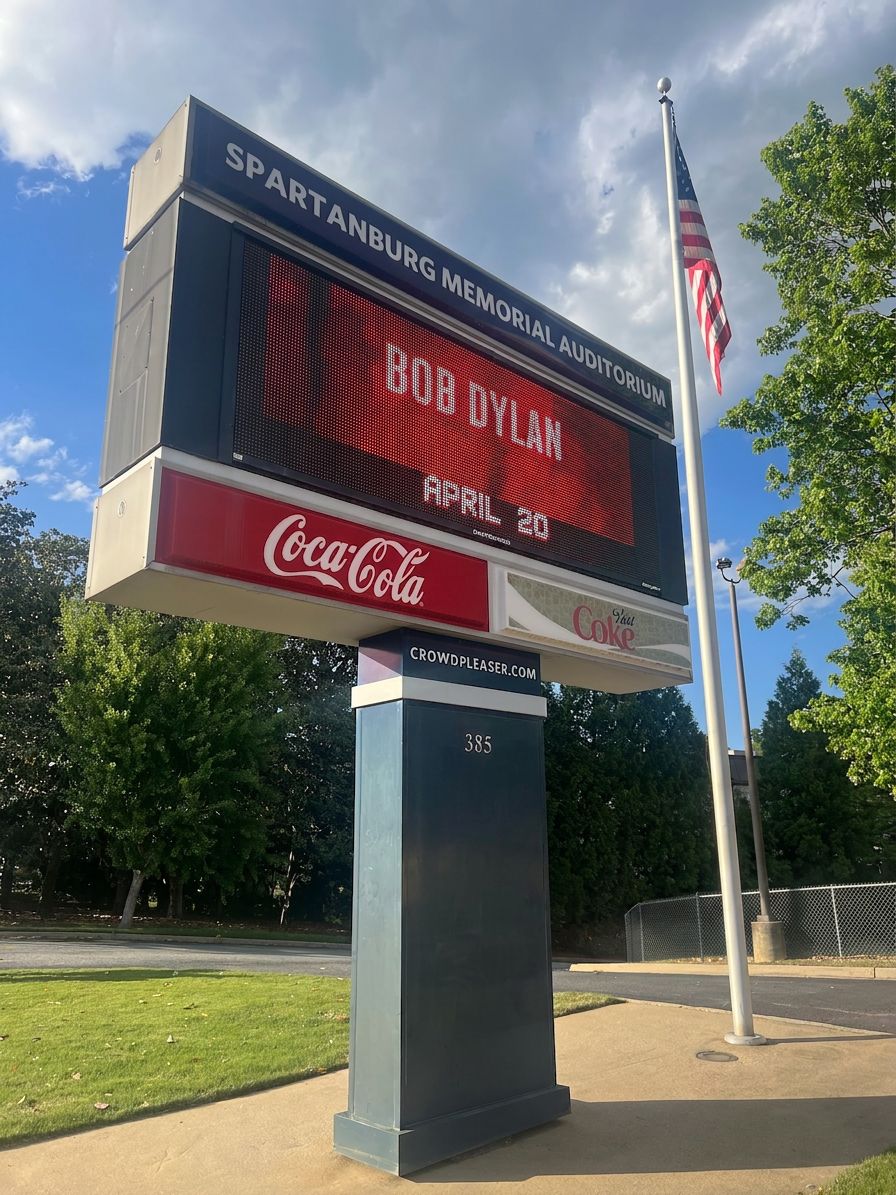
Bob Dylan – Spartanburg, SC
This week’s concert featured Bob Dylan, an artist whose influence on modern songwriting is difficult to overstate, even if his contemporary live performances are often met with skepticism. I went in with tempered expectations, shaped less by his recorded legacy than by the consistent discourse surrounding his vocal delivery and unconventional approach to performance.
The show took place at Memorial Auditorium in Spartanburg, South Carolina, an intimate, historic venue with a capacity of just over 3,000 and a sold-out crowd. The experience was immediately shaped by strict audience controls: phones were sealed in magnetic pouches upon entry, removing the usual digital layer from the room entirely. Combined with a stripped-down merchandise setup—no programs or recent imagery—the atmosphere felt deliberately removed from modern concert framing.
The result was an unusually present audience. Without screens to divide attention, focus shifted naturally toward the room itself. Conversations before the show carried clearly across rows, and the crowd felt more actively observant than passively waiting. A brief exchange with a Judas Priest fan from the UK underscored Dylan’s wider cultural reach, noting the band’s name origin from one of his songs—a small but telling reminder of his influence across genres and generations.
The performance began promptly at 8:00 p.m. with a tight five-piece band. Dylan remained behind a keyboard for most of the set, with guitar entirely absent and harmonica appearing only briefly. Any early concern around his vocal condition quickly faded; his voice carried a steady, controlled delivery that remained consistent throughout the night. Rather than emphasizing range or projection, the performance relied on phrasing and restraint, supported by a band that was precise, muted, and structurally disciplined. At 83, the focus was clearly on control rather than display.
Visually, the staging was minimal to the point of anonymity. Dylan, dressed casually in a hoodie, remained seated in low light near the drummer and was often partially obscured. There was no conventional stage presence—no banter, no performance theatrics, and only a brief mid-set introduction of the band. The effect was closer to a contained musical environment than a traditional concert.
One of the most striking moments came during “All Along the Watchtower.” The arrangement was so heavily reworked that recognition unfolded gradually rather than immediately. Stripped of its familiar structure, the song felt less like a reinterpretation and more like a reconstruction—familiar in material, but reshaped in form and emphasis.
That approach defines the broader performance. This is not a nostalgia-driven set built around faithful renditions or immediate recognition. Instead, it prioritizes reinterpretation and structural distance, rewarding close attention while challenging expectations of accessibility.
Dylan delivered a 16-song set drawn primarily from Rough and Rowdy Ways, supplemented by select older material and covers.
Setlist Highlights
- “All Along the Watchtower”
- “Black Rider”
- “I’ve Made Up My Mind to Give Myself to You”
- “Nervous Breakdown” (Eddie Cochran cover)
Verdict: 7.5 /10
Dylan delivered a set that resisted easy familiarity. The arrangements were stripped-back and functional, executed by a disciplined band that prioritized structure over spectacle. While the aesthetic is more minimal and utilitarian than what I typically gravitate toward, its internal logic became clearer in the live setting.
Despite the restrained staging, Dylan maintained a steady hold over the audience throughout. It is not an accessible or nostalgia-driven show, but a controlled and intentional one. A strong performance overall, and well worth seeing—particularly for listeners already engaged with his work. I was surprised and impressed!





Leave a Reply